Developmental Affordances: Creating conditions that maximise the potential of the adolescent brain
Coaches work incredibly hard to create the environments that help young players learn and develop. Their practice incorporates a blend of lived experience, coach education and coaching culture. I believe that new insights from the sciences of Mind, Brain and Education can add another lens. One that looks to bring together understandings from developmental neuroscience and psychology with existing perspectives from coaching pedagogy and practice - in the aim of offering a more holistic perspective on player development.
The new science is suggesting that young people are different and that their developing brain is hungry for the experiences that help them evolve from dependent child to independent adult.
What is the adolescent brain both ‘ripe and ready’ and ‘on the look-out’ to learn?
Recent advances in developmental neuroscience tell us that adolescence is not simply a transition between childhood and adulthood - it is one of the most powerful learning windows across the lifespan. During these years, science now suggests that young people are biologically primed to develop new ways of thinking, behaving and relating to others. Their brains are especially sensitive to experiences that foster independence, identity, curiosity, belonging and emotional growth.
For academy football coaches, this presents a great opportunity.
The challenge is not simply to design better football practices - it is to create environments that capitalise on the unique learning potential of adolescence.
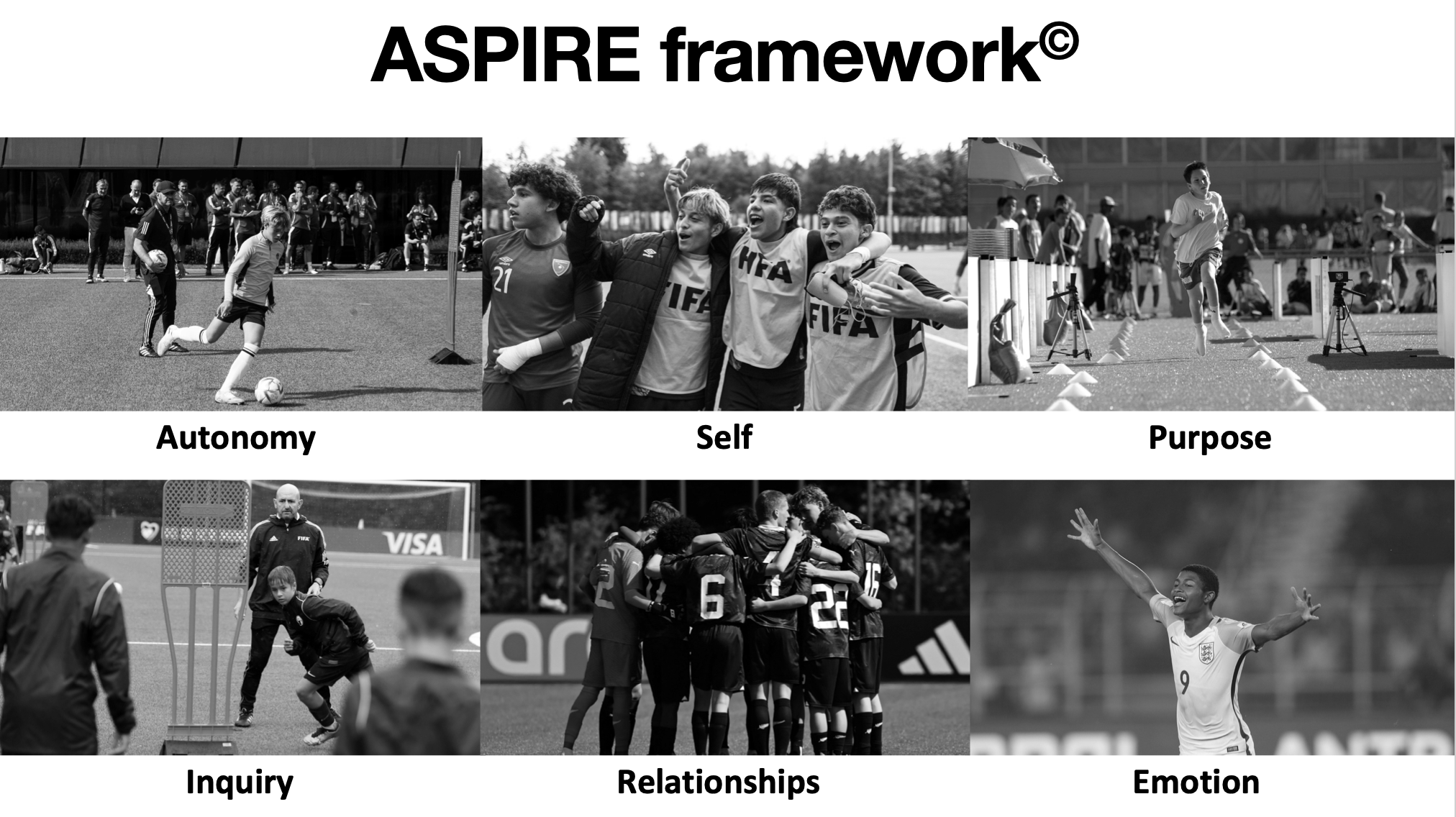
This is the thinking behind a model I created termed the ASPIRE Framework©. One that seeks to blend learning principles from developmental neuroscience with what we already understand from psychology and coach education. A model that can helps coaches think about the psych-social aspects of their craft - a fundamental area of development that, in my experience, is often left to chance.
Adolescent-specific Affordances
Within Ecological Dynamics, coaches often talk about affordances - the opportunities for action that emerge through the interaction of the individual, the task and the environment.
A well-designed practice might invite players to recognise a pressing trigger, exploit space between lines or identify when to dribble versus pass. These are football affordances that improve perception, decision-making and action.
However, insights from adolescent neuroscience invite coaches to think more specifically about this stage.To appreciate the specific wants, needs and capabilities that are coming-on-line. Also, young people are not only searching for football solutions; they are also hungry for opportunities to become more independent, discover who they are, build meaningful relationships and develop emotional resilience.
These are what I refer to as ‘developmental affordances’.
Developmental affordances are experiences that adolescents are naturally motivated to seek, practise and refine because they align with the unique characteristics of the developing brain.
These unique adolescent affordances can supplement the existing technical, tactical, physical and psychological lens: new knowledge that can help coaches intentionally create environments that support the developing person.
This is where the ASPIRE Framework© complements Ecological Dynamics.
Ecological Dynamics explains how learning can emerge through interaction with affordances. The ASPIRE Framework© helps coaches identify which developmental affordances adolescents are biologically and psychologically primed to engage with.
DEVELOPMENTAL AFFORDANCES OF ADOLESCENCE
The Six Developmental Affordances of A S P I R E
A – Autonomy
Adolescents have a growing need for independence. Their brains are increasingly motivated by opportunities for independence and ownership; to develop a sense of agency. Coaches can help scaffold these emerging sensitivities by creating opportunities to:
make meaningful choices
solve problems independently
take responsibility for learning
contribute ideas
Constraint-led practice naturally supports autonomy and agency because players discover solutions rather than reproduce instructions.
S – Self
Adolescence is the period when young people begin asking some of life's biggest questions: Who am I?/Where do I belong?/What do I value?/ What am I capable?/What can I achieve? Their sense of self is being moulded by their experiences, peers and the behaviours of significant adults (especially coaches).
Academy football can either strengthen or narrow these processes. What ‘sense of self’ is the academy environment helping to shape? Is it safe to be creative, to take risks, to make mistakes, to ask questions?
Supporting self-development means creating opportunities for reflection, self-awareness and understanding personal strengths. Players who understand themselves become better learners because they recognise which opportunities best fit their own capabilities.
P – Purpose
As the mid-to-late adolescent brain begins to connect across more distant pathways, young players are developing capacities to grapple with their values, meanings, and wider causes beyond themselves. Purpose can be a motivator, a reason to persist when training becomes difficult.
Instead of simply explaining what players are doing, coaches increasingly explain why. Connecting learning to long-term goals and heartfelt passions can create intrinsic motivation that extends far beyond today's session.
I – Inquiry
The adolescent brain is naturally curious and sensitive to novelty. Attuned for exploration and risk. Rather than providing the answers, coaches might ask pertinent, open questions.
- ‘How might we break the lines?’
- ‘Think of the consequences if we play this shape?’
- ‘Think of different ways to combine in the midfield?’
- Or develop the courage to sometimes stay quiet. Let the player figure out for themselves through trial and error and real-time feedback. Something their brains are designed to do.
Building a sense of inquiry in sessions encourages natural drives for exploration, curiosity and creativity. This suggests creating the conditions where young people are encouraged to take risks, be innovative and to embrace - not fear ‘failure’.
R – Relationships
Adolescent brains are primed to forge connections with peers and significant adults. Few things matter more to adolescents than belonging. Relationships are not an optional extra in player development - they are one of the strongest developmental affordances available to coaches.
Positive coach-player relationships create psychological safety. Positive teammate relationships create collaboration. Together they allow players to take intelligent risks, learn from mistakes and develop confidence.
E – Emotion
Adolescence is a time of heightened emotion. Football is an emotional game. As such it offers a great opportunity to help young players understand and regulate their emotions. Football can be a vehicle for helping young players manage their emotions.
Representative practices that include pressure, competition, uncertainty and consequence help players understand, and gradually learn emotional regulation alongside technical and tactical skill.
The objective is not to eliminate emotion but to help players recognise and embrace their emotions.
Designing Environments, Not Delivering Sessions
Perhaps the biggest shift for academy coaches is moving from asking:
"What activity should I run today?"
to asking:
"What developmental affordances does today's environment invite?"
A small-sided game can become far more than a technical/tactical exercise if it intentionally provides opportunities for:
Autonomy - through player-led decisions
Self - through reflection
Purpose - through meaningful goals
Inquiry - through curiosity and exploration
Relationships - through collaboration
Emotion - through authentic challenge
A New Lens for Academy Coaching
Ecological Dynamics provides the mechanism of learning through perception, action and affordances. The ASPIRE Framework© helps identify the developmental affordances that the adolescent brain is uniquely "ripe and ready" to engage with.
The ultimate goal, beyond simply producing players who can solve football problems, is developing young people who are curious, self-aware, emotionally resilient, connected to others and capable of adapting in the ever-changing demands of football - and life.
When coaches intentionally design environments that match the motivations, drives and emerging capabilities of adolescence, they work to improve performance, well-being and, at the same time, help shape the development of the whole person.